
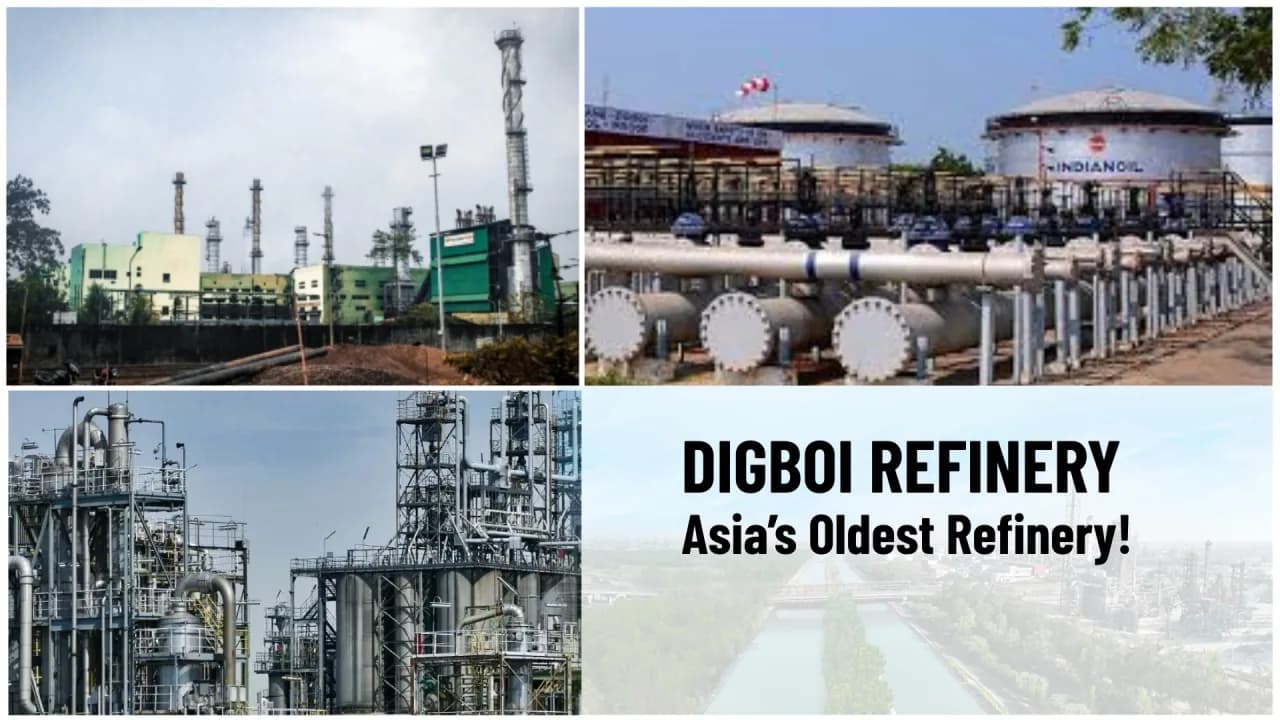
When India's energy story is told, the spotlight often falls on mega-refineries like Jamnagar, deepwater rigs, or BPCL's coastal terminals.
But long before all that — before digital twins, FPSOs, or even Independence — there was Digboi.
A patch of forest in upper Assam. A British engineer yelling “Dig, boy, dig!” And from there, a legacy was born.
Where it all began — Digboi, Assam (1901)
- Location: Tinsukia District, Assam
- Asia's first refinery, established by Assam Oil Company in 1901
- World's second oldest continuously operating refinery
- Still operational under Indian Oil Corporation (IOCL) Digboi Division
Yes, the world's oldest continuously operating refinery is in India and it's not just a relic. It's a running, modernized asset.
From colonial outpost to engineering marvel
Then
- Capacity: a few thousand tonnes/year
- Equipment: open fire stills & batch kettles
- Transport: crude via elephants & mules
- Workforce: British engineers + Indian labourers
Now
- Capacity: 1.0 MMTPA (million metric tonnes per annum)
- Units: Hydrotreater-UOP, DHDS, Solvent Dewaxing, MSQ upgrades
- Automation: fully digitized and BS-VI compliant
- Owner: IOCL Digboi Division
Rare engineering trivia & hidden anecdotes
- Digboi was once on the global tech radar: in the 1920s, engineers from Shell and Standard Oil visited Digboi to study its resilient firebrick-based stills, a rare feat that predated Western modular setups.
- Elephant-powered oil transport: early crude was literally hauled by elephants to tanks, documented in a 1930s issue of Oil & Gas Journal, proving India's logistical ingenuity.
- Women in oil, the silent workforce: during WWII, Assamese women formed one of India's first female workforces in oil, handling payroll, dispatch, and coordination during wartime.
- Burmah Oil's war machine: Digboi was part of Britain's Burma Campaign supply chain, with the rail route to Tinsukia militarized to supply refined petroleum to Allied troops.
- The lost pipeline of 1941: a secret pipeline from Digboi to Tinsukia was abandoned due to Japanese air threats. Had it succeeded, Digboi might have become the Southeast Asia oil capital.
- Export-grade paraffin wax: Digboi produces microcrystalline paraffin wax so pure it's still exported to Europe for medical and cosmetic use under IOCL's specialty division.
- Employees preserve history: early refinery schematics, diaries, and even toolkits were preserved by employees themselves, forming India's first employee-led industrial archive.
- The oil sample library: the Centenary Museum features a glass-jar archive of crude samples from as early as 1902, used by scientists to study long-term hydrocarbon evolution.
What if Digboi never happened?
- Asia's refining story would've started elsewhere
- India may have relied longer on imports
- No early industrial hub in Assam
- No foundational energy infrastructure for post-independence expansion
Digboi didn't just refine oil, it refined India's industrial vision.
Engineering heritage preservation
The Digboi Centenary Museum, built near the Discovery Well, showcases:
- Original kettles and batch stills
- Women workforce memorabilia
- 100+ years of hydrocarbon records
This is not just a museum. It's a living lab of industrial evolution.
Recent developments
- Jyoti Ltd secured a ₹6.5 Cr contract to supply switchboards for Digboi expansion
- New hydroprocessing units & MSQ upgrades in progress
- IOCL to scale capacity while maintaining legacy operations
Final thoughts
Digboi is the Gangotri of Indian hydrocarbons. It's not a relic. It's a reminder. That engineering isn't just about what you build today, but what survives and adapts for tomorrow.
As India enters new frontiers of green energy, we must honor the quiet giants that got us here. India's oldest refinery is still running. Quietly. Efficiently. Meaningfully.