The spark (1955–1970)
India founded more than a company in 1956 — it embedded an energy mission. The Oil & Gas Directorate (1955) became the Oil & Natural Gas Commission on August 14, 1956, with a mandate to locate and develop hydrocarbons nationwide.
Early ONGC geologists pioneered without precedent, constructing rigs in swamps, laying seismic lines through forests, and mapping basins manually. By 1993, this commission evolved into Oil & Natural Gas Corporation Limited (ONGC Ltd.), marking India's shift from an exploration directorate to a globally competitive upstream enterprise.
The soil years: Assam, Cambay, Ankleshwar
ONGC's first operations were land-based — in Assam's muddy plains and tea gardens, extracting oil from the Lakwa and Geleki fields. Cambay and Ankleshwar in Gujarat unlocked additional reserves. Each discovery strengthened technical capabilities in seismic imaging, drilling discipline, and reservoir science.
The leap (1973–1980): Sagar Samrat & Mumbai High
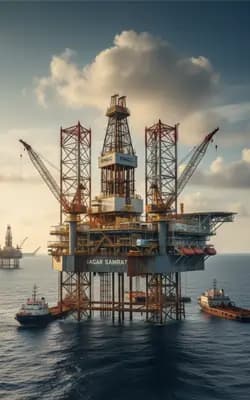
Summer 1973. The jack-up rig Sagar Samrat, built in Japan, entered the Arabian Sea as more declaration than machine.
In 1974, the first offshore well flowed, birthing Bombay High (now Mumbai High) 160 kilometers offshore in 75 meters of water. This discovery permanently altered India's energy trajectory, initiating offshore exploration expansion.
Fleet comes alive: the Sagar doctrine
From the 1980s onward, ONGC built its own fleet rather than renting.
“Sagar” — meaning sea — became both doctrine and design language. Shallow-water rigs included Sagar Shakti, Sagar Uday, Sagar Gaurav, Sagar Jyoti, Sagar Kiran, and Sagar Ratna. Deeper operations employed Sagar Vijay (1985) and Sagar Bhushan (1987), self-propelled drillships carrying India's flag into deeper waters.
The global arm — ONGC Videsh (1989)
India's ambitions extended beyond its coastline. ONGC launched ONGC Videsh Ltd (OVL) in 1989 as its international arm, investing in assets across Vietnam, Russia, Sudan, and Brazil, expanding India's energy presence to over 30 nations today.
Modern trials & brownfield mastery
As fields matured, ONGC pioneered Improved Oil Recovery (IOR) and Enhanced Oil Recovery (EOR) to sustain aging assets like Mumbai High. Retrofits, refurbishments, and conversions extended rig operational lifespans.
In 1995, the Pasarlapudi onshore blowout in Andhra Pradesh catalyzed safety culture transformation, training reforms, and well-control procedure improvements across operations.
By 2023, ONGC repositioned 36 offshore rigs before monsoon season — a logistical ballet of precision and discipline that showcased its unmatched offshore muscle.
Fleet renewal & strategic expansion
In 2021, ONGC ordered 47 new rigs (27 land + 20 workover) through MEIL and Drillmec, modernizing operational infrastructure.
Today's hybrid fleet includes six owned jack-ups, two drillships, and multiple contracted units (Compact Driller, Key Singapore, J.T. Angel, etc.). Domestic rig-building aspirations, dormant since the 1990s, are resurfacing.
Integration for the future — the HPCL chapter (2018)
In 2018, ONGC acquired a majority stake in Hindustan Petroleum Corporation Limited (HPCL), establishing India's first major upstream-to-downstream integration — connecting drilling platforms to fuel stations and creating a vertically integrated energy conglomerate.
Scale today & the path ahead
ONGC currently operates over 230 drilling and workover rigs nationwide, balancing heritage with innovation through jack-up conversions to production units, digital drilling dashboards, and predictive optimization systems.
Future development involves deeper waters, smarter wells, and cleaner production utilizing AI, robotics, and digital twins for hydrocarbon efficiency and safety advancement.
Following valuable feedback from an industry veteran
- Expanded fleet context (1980s acquisition): Sagar Pragati and Sagar Lakshmi were early jack-up acquisitions during the 1980s, marking India's indigenous offshore capability expansion.
- Operational status update: While Sagar Pragati and Sagar Lakshmi have been discontinued, the remaining six rigs continue operating, symbolizing fleet endurance and reliability.
- Corporate transition specifics: ONGC transitioned to a Corporation on July 2, 1993, under the Oil and Natural Gas Commission (Transfer of Undertaking and Repeal) Act, 1993, strengthening autonomy and global competitiveness.
- Updated hired rig information: Current operational support includes hired rigs such as Trident II, Admarine 9, and Admarine 11, demonstrating ONGC's strategy of integrating owned and chartered assets for sustained productivity.
SMEC's salute to an industry legend
SMEC has partnered with ONGC for over two decades, providing advanced automation, electrical, and instrumentation solutions across rigs, refineries, and offshore platforms. Services include PLC retrofits, SCADA modernization, panel engineering, real-time monitoring, and predictive diagnostics, maintaining India's energy heartbeat running — smarter, safer, and stronger.