Setting the stage: Assam's oil boom
The story begins in the lush green oilfields of Naharkatiya, Assam. By the 1950s, Assam was quietly becoming India's upstream powerhouse, with wells like Digboi, Moran, and Naharkatiya producing crude faster than the country could move it.
But there was a bottleneck. Despite the growing output, logistics were stuck in the colonial era:
- Crude was shipped in barrels on bullock carts
- Narrow-gauge railway lines ran through monsoon-flooded regions
- Roads were fragile, bridges outdated
It was crude extraction without efficient transport, a gap that made operations expensive and unsustainable.
Enter Oil India Limited (OIL)
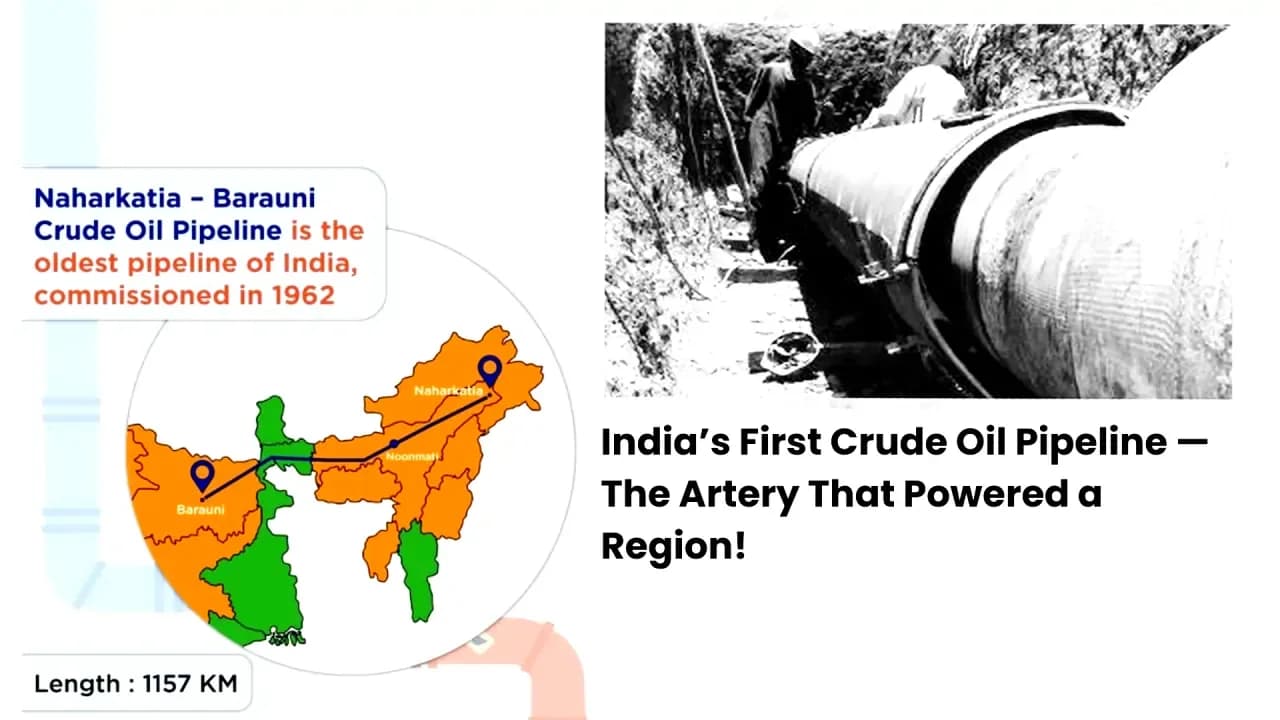
Post-independence, OIL (a joint venture between the Government of India and Burmah Oil), stepped in with a game-changing proposal: a crude oil pipeline from Naharkatiya to Noonmati (Guwahati), and eventually to Barauni (Bihar).
This was the first time India would attempt a long-distance pipeline, one that would cross:
- Swollen rivers like the Brahmaputra
- Dense jungles and hilly terrains
- Seismically active zones
It was not just a pipeline; it was a civil engineering feat wrapped in geopolitical strategy.
Construction highlights
- Commissioned in 1962
- Route: Naharkatiya → Noonmati (Refinery) → Barauni (via later extension)
- Length: ~1,157 km
Key milestones
- First use of buried pipelines in India
- Deployment of cathodic protection systems to fight corrosion
- Built 20+ river-crossing structures, including for the massive Brahmaputra
- Pipelines were tested at pressure beyond operational limits, a first in India
- The pipeline's SCADA-based upgrade in the 2000s made it one of the first in India to use leak detection algorithms
Did you know?
- The pipeline ran through 7 major rivers, including the Brahmaputra, requiring 20+ advanced river-crossing systems.
- The pipeline was built in record time, parts were commissioned even before the full route was complete to relieve storage bottlenecks in Assam.
- The project team included engineers trained in British, Soviet, and American techniques, making it a melting pot of global engineering styles.
- In the 1970s, the Barauni link enabled Assam oil to reach refineries catering to eastern and northern India, turning India from an oil “zone” to a connected “grid”.
- The pipeline corridor had to pause during floods, landslides, and even insurgent threats, making its completion as much a political act as an engineering one.
- Some pumping stations were powered using local hydroelectric generators due to lack of grid electricity in the 60s and 70s.
Strategic significance, then and now
- Unlocked crude viability in Assam by making transport scalable
- Established Oil India Ltd. as a leader in midstream infrastructure
- Built the backbone for future pipelines like Mundra-Bathinda, Salaya-Mathura, Paradip-Haldia
- Proved India could engineer and maintain high-volume energy corridors under its own flag
Even in 2025, this corridor continues to operate, smarter, stronger, and still critical.
Why it still matters today
- Parts of the original Naharkatiya–Noonmati pipeline corridor are active, upgraded with modern leak detection, IoT sensors, and digital twin overlays
- It set the standard for India's 4,000+ km of cross-country crude and product pipelines
- The pipeline marked the transition from colonial dependency to engineering self-reliance
From bullock carts to smart pipelines
The Naharkatiya–Noonmati–Barauni pipeline wasn't just metal and flow rate. It was intent. It was ambition. It was India saying:
We'll move our own oil. Our own way. At our own pace.
In today's world of predictive maintenance and AI-powered flow diagnostics, it's easy to forget where we started. But the legacy is still flowing, beneath soil, under rivers, across states.