A rig doesn't just produce oil, it produces reliability, one signal at a time.
The anatomy of reliability
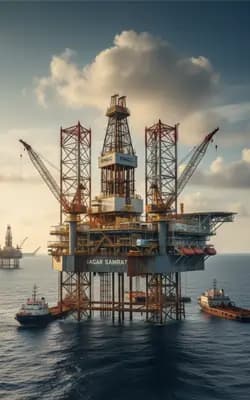
Whether it's a jack-up anchored off Abu Dhabi or a land rig drilling through shale in Gujarat, every rig shares the same lifeblood, systems that never sleep. Behind the rumble of generators and the spin of the top-drive lies a choreography of circuits, hydraulics, logic, and data. If one system fails, the others strain. If two fail, the rig stops breathing.
Let's uncover the twelve interlocked systems that keep both offshore and onshore rigs alive, validated against API RP 53, DNV-GL OS-D202, IEC 61511, and IEC 61892.
1. Power generation & distribution (PMS / SCR / VFD) — the heartbeat
Generates, manages, and distributes electrical power across all rig systems. Every control loop, from ESD logic to thruster control, depends on stable, synchronized power. A millisecond dip can cause a rig-wide blackout cascade.
- PMS (Power Management System) automatically synchronizes generators, balances load, and prevents overload.
- SCR (Silicon Controlled Rectifier) systems in land rigs modulate DC power for draw works and top-drives.
- VFDs (Variable Frequency Drives) regulate motor speed, reduce start-up surges, and extend equipment life.
On an offshore DP rig, the PMS works in closed feedback with DP and ESD, forming a real-time “triangular handshake” between power, motion, and safety. The hidden risk: generator desynchronization can trigger an AVR-hunting loop, a power oscillation that melts breakers and cascades into rig-wide blackout. Veterans call it the heart attack.
Current reading: more than 20% of offshore CAPEX retrofits now focus on PMS modernization. Digital twist: AI-based load forecasting plus digital-twin breaker analytics equals zero-downtime resilience.
2. Drilling / hoisting & load monitoring — the muscles
The muscles that move the drill string, top-drive, draw works, and mud pumps, deliver both power and precision. Load Monitoring Systems measure hook-load, torque, and bit pressure in real time. Data feeds to drill monitoring dashboards that predict stick-slip and vibration before failure.
The hidden risk: over-pull or unseen vibration can shear drill pipe connections and damage crown-blocks. Offshore, dynamic load cells and CBM integration reduce derrick fatigue; onshore, automated jacking and skidding systems cut rig move time by 25%. Condition-based load analytics cut draw works failures by 22%.
3. Well control / blow-out preventer (BOP) — the gatekeeper
The BOP is the iron wall between control and catastrophe. Hydraulic rams seal the wellbore at thousands of psi. Accumulators and choke manifolds regulate pressure surges, complying with API RP 53 testing intervals.
The hidden risk: a failed shear ram, as in Deepwater Horizon (2010), can rewrite history. Offshore, subsea BOP pods operate via redundant control lines; onshore, surface BOPs are easier to maintain but cycle twice as often. BOP market $1.2B → $1.9B by 2032.
4. Mud circulation & fluid monitoring — the lifeblood
Mud is the circulatory system of every well. It cools, lubricates, and balances pressure. Mud pumps circulate drilling fluid through shale shakers and desanders before returning downhole. Sensors track density, viscosity, and gas content.
The hidden risk: a 1 psi pressure imbalance can collapse the wellbore or cause a kick. Closed-loop mud systems cut spill risk by 40%. AI mud-rheology analytics predict density shift before loss of circulation.
5. Fire & gas detection / suppression — the guardian of seconds
When seconds decide survival, fire & gas is the system that buys them. Infrared, ultrasonic, and flame detectors feed to logic that activates deluge valves and shutdown signals per IEC 61511.
The hidden risk: delayed detection or false trip can be equally fatal — Piper Alpha (1988) proved it. Safety automation is now a $3.6B market. Gas-cloud mapping and sensor self-calibration minimize blind spots.
6. Emergency shutdown / safety instrumented system (SIS) — the parachute
When all else fails, this system saves lives. A layered shutdown hierarchy brings the rig to a safe state, linked to F&G and process control under DNV-GL OS-D202.
The hidden risk: improper setpoints or bypass logic can delay a trip by seconds, long enough to lose control. Automated SIS cut incidents by 30%. Virtual commissioning via digital twin (SMEC NexVerse) validates logic without production loss.
7. Process control & automation (DCS / SCADA / PLC) — the brain
The brain that thinks, responds, and records every action. Distributed Control Systems govern drilling, separation, and utilities. Supervisory SCADA systems aggregate data to the bridge or remote center.
The hidden risk: legacy PLCs over 20 years old introduce millisecond lags that compound under cyber load. 60% of operators plan DCS modernization by 2026. Edge computing plus AI fault-prediction gives self-healing control loops.
8. Structural integrity & load monitoring — the skeleton
The bones that bear the weight of steel, sea, and time. Sensors monitor hull stress, mooring tension, and foundation settlement. Data feeds into finite-element digital twins for fatigue prediction.
The hidden risk: undetected corrosion can propagate micro-fractures in jackets, responsible for 30% of failures (ABS 2023). ROV integrity inspections reduce manual dives by 60%. AI fatigue-analytics and ultrasonic mapping extend hull life by a decade.
9. Gas monitoring & environmental control — the lungs
Clean air is non-negotiable in confined environments. Continuous H₂S and CH₄ detection with auto-vent and flare logic maintains safe ppm levels.
The hidden risk: sensor poisoning or blockage can delay alarms by critical seconds. Gas monitoring incidents fell 40% after multi-sensor fusion (2024). Optical IR sensors and drone gas-visualization improve reach in hazard zones.
10. Communications & cyber defence — the nervous system
Data connectivity is now as vital as hydraulics. VSAT, microwave, and 5G links carry SCADA and crew comms. Cyber firewalls segregate OT and IT traffic.
The hidden risk: unpatched PLC gateways are attack magnets, with OT breaches up 30% (IBM 2024). Zero-Trust policies are now mandatory in new MODU designs. Cyber-twins simulate intrusion events to train SOCs remotely.
11. Drill monitoring & data acquisition (DAS / RTD) — the eyes and ears
Without feedback, you can't steer precision. Downhole sensors feed pressure, temperature, and vibration to surface DAS systems per API RP 7G. Real-time data optimizes bit performance and wellbore trajectory.
The hidden risk: signal latency over 3 seconds can mislead operators and cause kick misinterpretation. Smart DAS reduced NPT by 18% in 2024. Edge-AI models predict bit wear and ROP optimization autonomously.
12. Asset integrity & maintenance (CMMS / AMS) — the memory
The rig remembers, if you let it. CMMS tracks maintenance cycles, failure history, and critical spares, linked to DCS for condition-based alerts.
The hidden risk: out-of-sync maintenance data causes duplicate failures and spare stock shortages. Predictive integrity cuts downtime by 20%. SMEC's NexVerse digital twin plus ProSet360 gives maintenance and operations a single source of truth.
Conclusion: building intelligence into reliability
Across both offshore and onshore operations, every system that once acted in isolation is now part of an integrated intelligence network. Standards like API RP 53, DNV-GL OS-D202, and IEC 61511 remain the foundation of safety, but digital transformation is redefining how those standards are achieved.
AI analytics, digital twins, and edge computing are bridging engineering disciplines that were once siloed. Power, process, safety, and integrity now inform each other in real time. The measurable outcomes are undeniable:
- 20% less unplanned downtime
- 25% lower maintenance OPEX
- Higher energy efficiency and safety KPIs
The rigs of the future won't merely operate; they'll self-optimize. Reliability has become predictive, and intelligence has become the industry's new infrastructure.
At SMEC Automation, we see this transformation not as a shift in technology, but as a shift in thinking. Our role is to engineer intelligence into control, bridging legacy infrastructure with next-generation reliability. Because in modern energy operations, precision is power, and intelligence is the new uptime.