
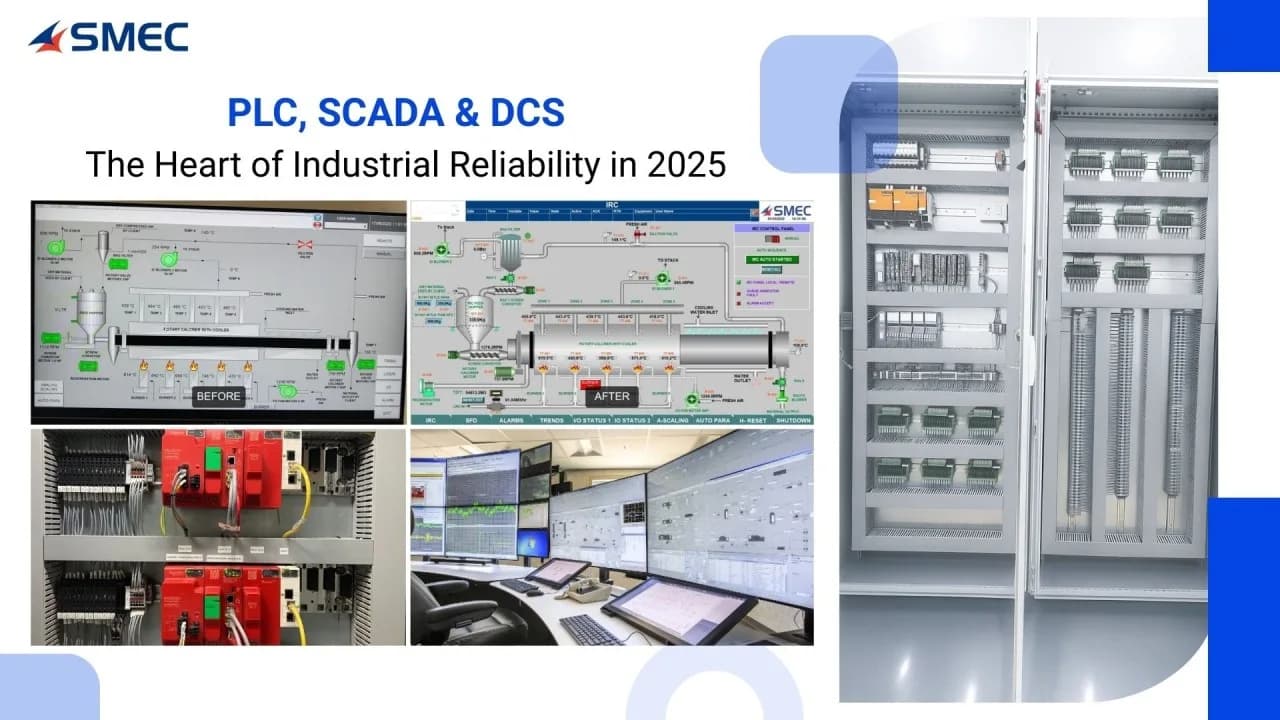
In today's energy, marine, and industrial landscapes, downtime is the single most expensive line item. Whether it's a rig in the Arabian Sea, a tanker in dry dock, or a refinery onshore, every hour of lost uptime translates into hundreds of thousands of dollars in losses, not to mention safety and compliance risks.
At the core of uptime lies one question: how strong, integrated, and future-ready are your control systems? This is where PLC, SCADA, and DCS step in. But while these three acronyms are used interchangeably, they serve distinct functions, and the future lies not in choosing one over the other, but in engineering them together intelligently.
PLC — the rugged backbone
PLCs are the workhorses of industrial automation.
- What they do: handle machine-level, high-speed control logic (motors, valves, compressors, pumps).
- Strengths: rugged, real-time, modular.
- Limitations: on their own, PLCs can't provide supervisory visibility or plant-wide intelligence.
The challenge today
- PLCs installed before 2010 are hitting obsolescence.
- Spare parts are scarce, vendor support ends, and downtime risk grows.
- Many operators keep “stretching” PLC life until failure forces an expensive replacement.
The opportunity
- Modern PLCs integrate seamlessly with SCADA/DCS.
- Protocols like Modbus, Profibus, and Ethernet/IP ensure connectivity across OEMs.
- PLC upgrades extend lifecycle 10+ years and enable condition monitoring at the edge.
SCADA — from monitoring to intelligence
Think of SCADA as the nervous system. It connects PLCs, RTUs, and sensors into one supervisory dashboard.
- What it does: centralizes monitoring, logs events, enables alarms, provides HMI interfaces.
- Strengths: excellent for distributed assets — offshore rigs, multi-plant operations, pipelines.
- Limitations: legacy SCADA floods operators with alarms, lacks predictive insights, and struggles with multi-protocol environments.
SCADA without analytics is just data noise. Many operators still rely on SCADA purely for visualization, missing predictive maintenance benefits. Next-gen SCADA integrates with ERP, CMMS and IoT sensors; adding condition-based monitoring turns alarms into actionable insights, and centralized dashboards enable decisions in minutes instead of days.
DCS — reliability at scale
DCS is the reliability anchor for large, continuous processes.
- What it does: distributes control across the plant, ensuring no single point of failure.
- Strengths: advanced process control, redundancy, reliability.
- Limitations: vendor lock-in, costly migrations, longer deployment times.
Plants struggle with obsolete DCS control cards. Migrations often risk long shutdowns and high costs, and cybersecurity vulnerabilities are growing in older DCS setups. Hybrid architectures deliver flexibility plus reliability; layering AI and digital twin technology provides predictive insights across the entire process, and modular upgrades allow phased migration without halting production.
The future: convergence, not silos
The real winners in oil & gas, marine, and industrial sectors won't be the companies with the best PLC, SCADA, or DCS in isolation. The winners will be those who engineer:
- PLCs for local precision
- SCADA for supervisory visibility
- DCS for process reliability
- All tied together with AI, digital twins, and condition-based monitoring
This convergence means less downtime through predictive trips instead of reactive failures, smarter OPEX decisions through energy savings and reduced spares, and longer lifecycle through retrofit readiness instead of replacement panic.
Conclusion
The age of siloed, vendor-locked PLCs, SCADA, and DCS is over. Leaders who treat control systems as isolated acronyms will keep fighting downtime, alarm floods, and rising OPEX. The future belongs to integrated, intelligent ecosystems that deliver uptime, visibility, and ROI across every asset.
So the real question is no longer “Is the PLC obsolete?” It's “How long can the operations afford to depend on outdated control systems?”
At SMEC, we've spent 25 years retrofitting, integrating, and future-proofing control systems for rigs, vessels, and industrial plants worldwide. Whether it's extending lifecycle by a decade, cutting downtime by 30%, or giving decision-makers one pane of glass for operations, we engineer reliability into every project.