
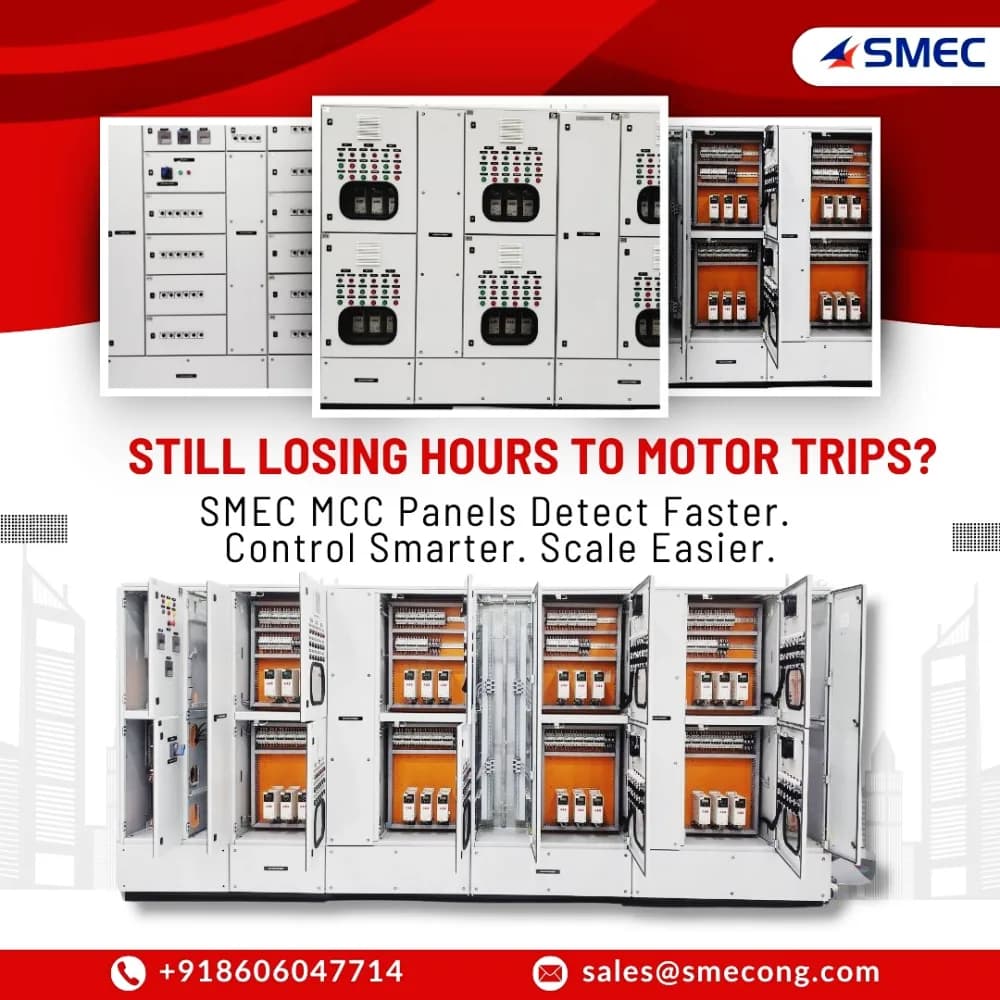
Open your control panel. Does it look like a masterpiece of engineering, or a bird's nest of “temporary” bypasses, jumpers, and unlabeled wires?
In marine, oil & gas, and heavy industries, panels are often treated as static infrastructure: installed once, modified endlessly, and understood by fewer people each year. That assumption is now one of the largest hidden risks to asset availability.
If your technical team needs a map, a flashlight, and a prayer to find a fault, your system isn't just old — it's obsolete. Whether it is a $50M vessel stuck at the pier or a high-output industrial plant facing a “mystery” trip, the cost of an un-engineered, messy panel is measured in massive hourly losses.
At SMEC Automation, we don't just wire boxes. We engineer the central nervous system of your entire operation. This article breaks down critical panel systems, not as products, but as decision-making organs of modern assets.
The evolution of the panel
- The age of iron (relay logic): robust but “dumb”. Troubleshooting a single failed relay in a sequence of fifty takes hours of manual testing.
- The “spaghetti” era (hybrid systems): this is the danger zone. Digital meters tacked on to 30-year-old iron. A mix of analog noise and digital logic that no one fully understands.
- The SMEC intelligent era (2026 standards): we replace miles of redundant wiring with a single industrial backbone. Our panels communicate, self-diagnose, and self-protect.
1. Emergency control panels
When seconds matter, logic integrity matters more than hardware. Emergency control panels are rarely complex by component count. They are complex by decision density. Most start life as clean, deterministic systems — hardwired, linear, and easy to reason about. The problem begins when the asset evolves but the emergency philosophy does not.
- Emergency stop chains expanded incrementally without re-verifying priority hierarchy
- Safety inputs added as parallel permissives instead of restructured logic paths
- Latched emergency states that do not reset cleanly after transient undervoltage or blackout recovery
Emergency panel failures are rarely caused by contactors or relays failing. They are caused by logic paths that were never tested together under dynamic failure sequences. Emergency panels must be validated using sequence-based failure simulations, not static I/O checks.
2. RTU panels
Data without authority is operational noise. RTU panels are often deployed to increase visibility, but visibility without decision authority creates confusion, not control.
- RTUs polling faster than the upstream SCADA can process, creating timestamp ambiguity
- Drift between RTU clocks and master systems leading to incorrect event sequencing
- Alarms generated without defined escalation ownership
RTUs must sit at the boundary between detection and action: alarm prioritization tied to response time rather than signal importance, clear separation between advisory data and actionable triggers, and deterministic communication paths for emergency or protective signals. An RTU that only reports conditions after margins are lost is not a control asset. It is a historian input.
3. Motor control centers (MCC)
Where electrical protection and mechanical behavior collide. MCCs are often upgraded for higher motor ratings, VFD integration, or redundancy — but rarely re-engineered for behavior under stress.
- Unequal thermal loading across incomers causing asymmetric aging
- Protection curves still tuned to original motor inertia, not retrofitted drives
- Short-circuit coordination compromised by partial upgrades
A safe MCC is not defined by nameplate margins. It is defined by thermal profiling across operating envelopes, protection selectivity validated during non-ideal fault paths, and starter logic that accounts for degraded motor characteristics. An MCC can energize motors flawlessly and still be operationally unsafe.
4. Power control panels
Power availability is electrical. Power stability is control logic. Power control panels fail most often during transitions, not during faults.
- Logic designed around steady-state assumptions
- Control wiring routed alongside power paths, inducing noise during switching
- Manual overrides introduced without logic-state reconciliation
When loads shift rapidly or generators synchronize, control logic must arbitrate conflicting priorities in milliseconds. Power stability is governed by decision timing, not breaker speed.
5. PLCC & distribution panels
When signal integrity is mistaken for equipment failure. PLCC panels rarely fail outright. They degrade.
- Harmonic injection from VFDs overwhelming carrier frequencies
- Earthing schemes incompatible with modern electronic loads
- Attenuation misinterpreted as relay malfunction
Most PLCC failures are system-integration failures, not communication failures. Distribution panels must be engineered as part of the signal environment, not just power routing hardware.
6. Main switchboard (MSB)
Blackouts begin during coordination, not collapse. The MSB is where electrical power becomes operational decision-making.
- Protection discrimination not revisited after generator upgrades
- Load-sharing logic assuming ideal governor behavior
- Manual restoration sequences executed under time pressure
Blackouts rarely result from a single catastrophic fault. They emerge from minor misalignments during transitions — synchronization, fault clearance, or load pickup. An MSB must be validated for transition behavior, not just fault isolation.
7. Emergency switchboard (ESB)
Redundancy without coordination is false security. ESBs are often treated as isolated safety islands, which creates blind spots: transfer delays during undervoltage recovery, emergency loads exceeding assumed duty cycles, and battery systems sized for drawings rather than reality. An ESB must mirror the decision philosophy of the MSB, not merely duplicate hardware.
8. Power management system (PMS) panels
Where logic ages faster than hardware. PMS panels fail quietly, through logic drift: load-shedding thresholds based on obsolete consumption data, generator sequencing tuned to new machines but applied to aged ones, and incremental logic edits without full-system simulation. A PMS that passes trials can still collapse under operational stress.
9. Shore power connection panels
Grid integration, not plug-and-play compliance. Shore power systems introduce two grids with different assumptions: harmonic resonance between shore supply and onboard converters, isolation logic that fails during abnormal transitions, and transients damaging sensitive electronics during connection and disconnection. Shore power panels are grid-integration systems. They must manage synchronization, isolation, and protection dynamically, not statically.
10. Distribution boards (DBs)
Where small failures cascade. Distribution boards are the most underestimated risk nodes: critical and non-critical loads mixed without priority logic, breakers drifting from original trip characteristics, and no visibility into downstream degradation. DBs are not secondary hardware. They are failure multipliers if engineered casually.
Why SMEC panels outperform
- The digital bridge (logic conversion): you don't need to scrap a $1M engine or machine just because the OEM panel is obsolete. We engineer custom panels that speak to 30-year-old sensors while giving you 2026-level diagnostic data. We upgrade the brain; you keep the iron.
- Phased modernization (the zero-blackout upgrade): you don't need a total shutdown to upgrade your main switchboard. Our experts replace vital organs — breakers and protection relays — in modular stages during scheduled windows.
- Thermal intelligence: most panels fail because of heat-creep. SMEC panels use laser-mapped airflow and infrared-ready inspection ports, allowing you to scan for hot-spots without ever breaking the arc flash boundary.
Global powerhouse: India & UAE
Our UAE facility has been specifically designed to handle the rapid-response needs of the Middle Eastern energy and maritime sectors. Whether it is a custom MSB retrofit or a new RTU deployment, our UAE and India teams operate under a unified single standard of excellence.
If your engineers are relying on a map and a prayer, your system is a ticking clock. Whether you are in a factory in India or a vessel in the Arabian Gulf, SMEC builds for the 25-year life of your asset. We aren't just experts in panels — we are the architects of your uptime.